



-

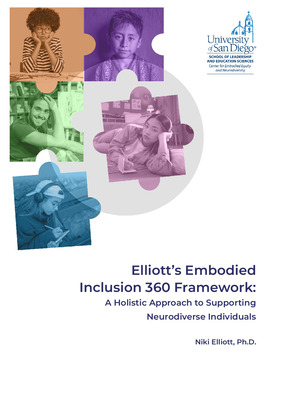
Elliott’s Embodied Inclusion 360 Framework: A Holistic Approach to Supporting Neurodiverse Individuals
Niki Elliott Ph.D.
The embodied inclusion (EI) 360 framework asserts that authentic inclusion requires adapting environments in support of neurodiverse learners. The EI 360 model offers an urgently needed synthesis of intersecting theories and practices that are too often addressed in silos: educational neuroscience, trauma-informed teaching, social–emotional learning, inclusive education, and culturally responsive pedagogy. The framework identifies five core domains (i.e., physiological, relational, environmental, instructional, and transcendental) that form a cohesive lens through which to understand and respond to learner needs. Each domain contributes valuable insight into neurodiverse learner neurobiology, replacing fragmented, incomplete support plans with an integrated, individualized profile of a learner’s strengths, challenges, and needs. The EI 360 framework offers an integrated lens that empowers educators to design learning experiences that honor the full complexity of neurodiverse learners.
-
Sensory Profile: Understanding Soothers and Stressors
Niki Elliott Ph.D.
Sensory experiences shape how we move through the world: how we learn, focus, connect with others, and sustain energy across the day. For neurodiverse individuals in particular, sensory input is often central to how environments are experienced. Stress, fatigue, withdrawal, or overwhelm often emerge from a mismatch between a person’s sensory needs and the environments they are navigating, rather than from individual deficits or lack of effort. Lighting, noise, movement demands, unpredictability, clutter, and even well-intentioned routines can either support ease and participation or place additional strain on the nervous system. This Sensory Profile is designed to help individuals and educators notice patterns, build awareness, and make intentional design choices whether in classrooms, campuses, workplaces, or daily life by better aligning environments to human nervous systems.
Printing is not supported at the primary Gallery Thumbnail page. Please first navigate to a specific Image before printing.