









-
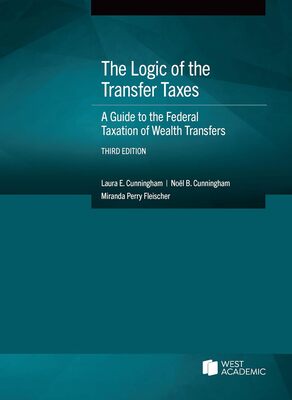
The Logic of the Transfer Taxes: A Guide to the Federal Taxation of Wealth Transfers
Laura E. Cunningham, Noel B. Cunningham, and Miranda Perry Fleischer
The Logic of the Transfer Taxes: A Guide to the Federal Taxation of Wealth Transfers offers a broad survey of the federal transfer tax system. It thoroughly covers all of the fundamental rules of the gift, estate and generation-skipping transfer taxes and provides numerous illustrative examples. It also offers a glimpse of some popular tax planning techniques, including FLPs, GRATs and IDGTs, and the special valuation rules of Chapter 14. It is appropriate for use as a coursebook for a two- or three-credit JD or LLM course, or as a reference for newcomers to the area.
The Third Edition incorporates changes to the law made by The One Big, Beautiful Bill Act, which makes permanent many of the temporary changes made by the Tax Cuts and Jobs Act of 2017. All of the illustrations are updated to reflect the new exclusion amounts. Since the debate over whether or not to tax wealth continues, the authors have expanded their analysis of this fundamental issue. The Third Edition also expands coverage of both the charitable and the marital deductions. In the charitable deduction section, there are several new illustrations of how split-interest gifts are currently treated and how they are used to achieve various estate planning goals. In the marital deduction section, the authors discuss and illustrate how to ensure that both spouses’ exclusion amounts are fully utilized.
-
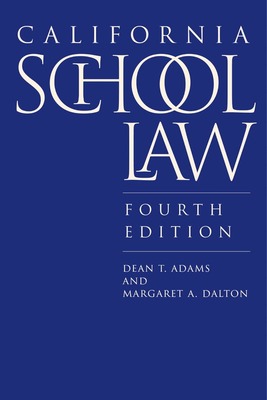
California School Law
Margaret Dalton and Dean T. Adams
California School Law provides an accessible, comprehensive source for the latest law and policy in this rapidly changing and critical field. Earlier editions of the book, authored by Frank Kemerer and Peter Sansom, have become coveted desktop references for administrators, governing board members, education attorneys, union leaders, and policymakers. In this updated and expanded fourth edition, Dean T. Adams and Margaret A. Dalton bring this analysis up to the present, including examining California's often unique state law as well as applicable federal law, and exploring how they combine to affect the day-to-day operation of the state's traditional public, charter, and private schools.
Beginning with an explanation of the legal framework for California schooling, the book moves quickly to examine important areas of law including curriculum, teacher and student rights of expression, religion in the public school setting, racial and gender discrimination, students with disabilities, student discipline, privacy, search and seizure, and legal liability in both state and federal court. Also included are chapters on unions and collective bargaining, employment, and educational finance issues.
Law never stands still and is proceeding at a record pace in education. This book is an invaluable tool for readers who wish to obtain a working knowledge of this extensive area of education law.
-
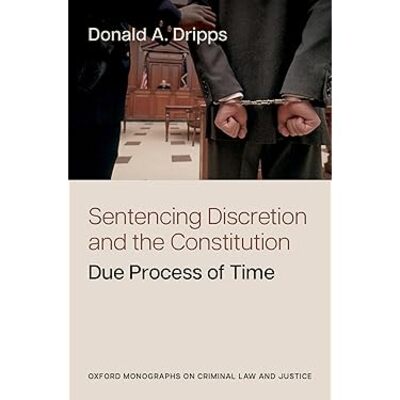
Sentencing Discretion and the Constitution: Due Process of Time
Donald A. Dripps
The U.S. Supreme Court maintains that prosecutorial discretion to charge different offenses authorized by the penal code is practically limited only by the penal code itself. Because typical offense conduct violates multiple statutes carrying different maximum—and minimum—sentences, by choosing the charge, the prosecution commonly also chooses the sentence. The Court, however, holds that when judges exercise sentencing discretion, due process requires impeccable neutrality and adversary hearings.
Sentencing Discretion and the Constitution: Due Process of Time addresses the fundamental incompatibility of the U.S. Supreme Court's approach to the sentencing power of judges as compared to prosecutors. The Court says that when prosecutors induce a guilty plea by filing lesser charges than the code allows, the defendant is getting a break rather than being strong-armed. This doctrinal fiction persists because neither dissenting justices nor academic critics have yet justified a baseline by which the infliction of years—or even decades—in prison for refusing to plead guilty or to provide information, should be treated as a coercive threat rather than an offer permitted in the "give and take" of plea bargaining. In theory, the charges filed should be proportional to culpability, not the most severe the code permits. This raises another hard problem: theorists have not to date advanced a persuasive account of proportionate punishment.
Unlike prior works, Sentencing Discretion and the Constitution exposes the connections between these problems and proposes a unified solution. The right against excessive punishment, like the right against erroneous conviction, is best understood as a right to procedural justice. More broadly, curtailing prosecutorial sentencing is an essential step toward curtailing mass incarceration—a problem that otherwise is more likely to get worse than better.
This book will be of interest to readers concerned with plea bargaining, sentencing, constitutional law, legal history, and criminal law theory.
-
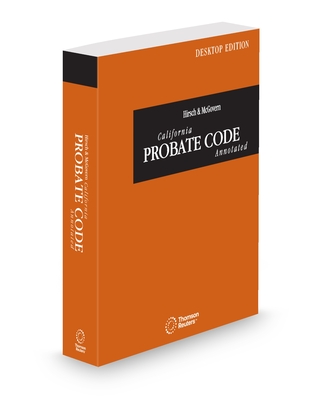
California Probate Code Annotated
Adam Hirsch and William M. McGovern Jr.
Hirsch & McGovern California Probate Code Annotated (California Desktop Codes) is your comprehensive resource for probate law and estate planning in California. It provides you with the complete text of the California Probate Code, related state and federal statutes, and rules of court regarding estate planning and probate.
This volume contains:
- Authoritative commentary, annotations, and analysis of leading cases
- Law Revision Commission editorial notes that provide additional guidance in the construction and application of particular sections
- Reference to Witkin's Summary of California Law, 10th Edition, which direct you toward further research
- A table of Judicial Council forms to help you identify forms to be used with the statutes and rules
- A table of cases illustrating the cases discussed in the author's commentary
- A table of affected sections indicating recent modifications
- Underlining to indicate additions or changes in statutes
- Asterisks to indicate deletions
-
California White Collar Crime and Business Litigation
Thomas A. Papageorge and Robert C. Fellmeth
This comprehensive reference is on the desks of many of the state's most respected criminal and civil practitioners. No other single volume covers all forms of substantive economic crimes and civil offenses and the procedural issues important in California business law:
- Complex Theft and Embezzlement
- Antitrust and unfair Competition
- Consumer Fraud and Unfair Trade Practices
- Securities Offenses
- Business & Investment Opportunities
- Real Estate, Construction, and Predatory Lending
- High Technology Crime
- Commercial Bribery and Unlawful Rebates
- Tax Law Violations
- Environmental, Health & Regulatory Violations
- Political Crimes and Racketeering
- Corporation/Officer Liability
- Search Warrants, Administrative Subpoenas, the Grand Jury, Undercover Investigations, and many other procedural issues
-
Trademarks and Free Speech: Conflicts and Resolutions
Lisa P. Ramsey
This book explores how trademark laws can conflict with the right to freedom of expression and proposes a framework for evaluating free speech challenges to trademark registration and enforcement laws. It also explains why granting trademark rights in informational terms, political messages, widely used phrases, decorative product features, and other language and designs with substantial pre-existing communicative value can harm free expression and fair competition. Lisa P. Ramsey encourages governments to not register or protect broad trademark rights in these types of inherently valuable expression. She also recommends that trademark statutes explicitly allow certain informational, expressive, and decorative fair uses of another's trademark, and proposes other speech-protective and pro-competitive reforms of trademark law for consideration by legislatures, courts, and trademark offices in the United States, Europe, and other countries.
-
Wrongful Convictions: Cases and Materials
Justin Brooks
Wrongful Convictions: Cases and Materials is the first legal textbook to explore the complex and fascinating legal and scientific issues involved in wrongful convictions and the exoneration of the innocent. This exciting area of the law is developing at a rapid pace as we learn more about the causes of wrongful conviction with each exoneration. The book is designed to teach about procedure related to the cases, as well as give a broad overview of the causes of wrongful convictions including false eyewitness testimony, false confessions, ineffective assistance of counsel, police and prosecutorial misconduct, and false forensic evidence. In this fourth edition, there have been significant updates to the cases from the previous edition, including an additional chapter on wrongful conviction civil suits.
-
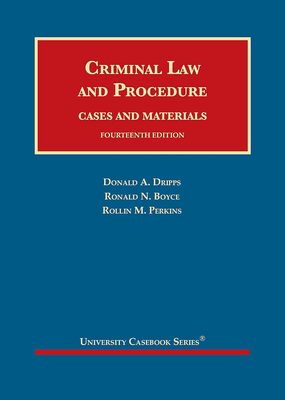
Criminal Law and Procedure, Cases and Materials
Donald A. Dripps, Ronald N. Boyce, and Rollin M. Perkins
The 15th Edition continues the book's commitment to offering the most comprehensive, rigorous, and flexible materials on the American criminal process. With respect to the substantive criminal law, the new edition includes:
- Full case treatment of new cases from the Supreme Court, including City of Grants Pass, Oregon v. Johnson, 144 S.Ct. 2202 (2024) (rejecting an Eighth Amendment challenge to an ordinance prohibiting sleeping in public), Ruan v. United States, 597 U.S. 450 (2022) (requiring proof of scienter to convict a doctor of felony drug trafficking), and Ramos v. Louisiana, 590 U.S. 83 (2020) (holding that the Fourteenth Amendment incorporates not just the Sixth Amendment right to jury trial, but also the requirement that the jury be unanimous to convict), together with a much-condensed presentation of Dobbs v. Jackson Women's Health Organization, 597 U.S. 215 (2022) (Roe is overruled; what now about Lawrence?);
- Important new lower courts cases on the void-for-vagueness doctrine, the Second Amendment, homicide, and insanity;
- An update to the causation section;
- The addition, to Chapter 11, of a brief new Section 6 on Executive Clemency;
- A focus on cases that reflect topical issues, including homelessness, gun rights, reproductive rights, drug sales causing death, and parental liability for mass shootings by their minor children;
- A pervasive effort to condense material, either by cutting some material from cases as they appeared in the Fourteenth Edition, or substituting newer and shorter cases for older and longer ones.
-
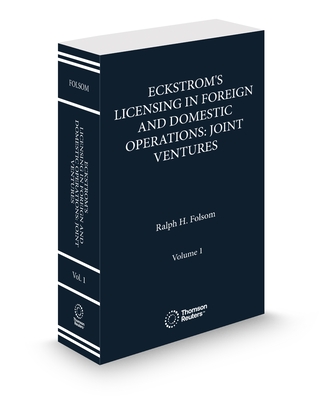
Eckstroms Licensing In Foreign and Domestic Operations Joint Ventures
Ralph Folsom
This title offers pivotal insights into the techniques, considerations, potential pitfalls, and remedies involved in forming international businesses and joint ventures. It covers the primary considerations of setting up an international business; management structure of the agreement; checklists, ancillary agreements, and arbitration; legal restrictions; research and development; taxation; financing and insurance; and taxation of international technology transfers. The following business information is also available for selected countries: survey of the economy, governmental controls on investment, tax structures, foreign exchange, banking system, labor problems, controls on licensing and intellectual property protection, and an overview of intellectual property law.
-
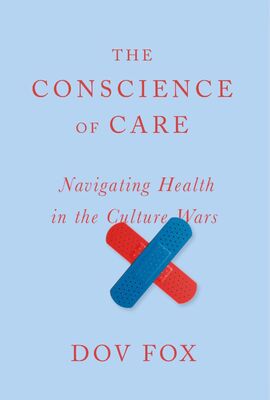
The Conscience of Care: Navigating Health in the Culture Wars
Dov Fox
Amid historic restrictions on abortion, puberty blockers, and assisted suicide, a health-law expert exposes America’s broken system of medical conscience, which shields clinicians who refuse evidence-based care yet offers no protections to those who provide prohibited treatment.
Pitched battles over abortion, puberty blockers, and assisted suicide have turned American healthcare into a legal minefield. Faced with mounting restrictions on medical practice, doctors and nurses who follow their conscience to provide standard treatments risk being fined, fired, or even imprisoned, while clinicians who conscientiously deny evidence-based care are shielded without condition from any such consequences. Dov Fox argues that by ceding the moral vocabulary of conscience to refusers alone, the lopsided law of medical conscience selectively burdens providers, drives vulnerable patients underground, and impoverishes the dynamic pluralism of medicine.
The Conscience of Care lays bare the broken system of medical conscience and sets out to fix it. Fox canvases a landscape of contested services that include IVF, IUDs, opioids, psychedelics, organ transplants, and advance directives. He develops practical reforms that rebalance conscience protection by introducing measured safeguards for providers and scaling back the categorical refuge afforded to refusers. The Conscience of Care articulates a bold vision of medicine that reclaims the lost promise of conscience to bridge social divides on matters of life and death, impairment and identity.
-
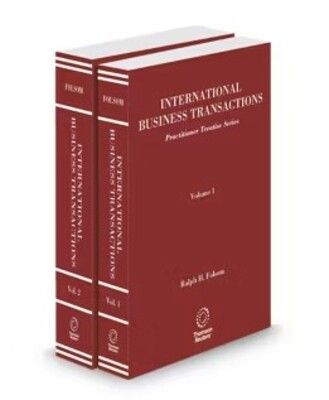
International Business Transactions Practitioner Treatise
Ralph Folsom
Global in scope, this title covers topics including: international sales law; commercial terms; bills of lading; distributorship agreements; letters of credit; e-commerce; trade law and remedies; the World Trade Organization; customs law; antidumping and countervailing duties; safeguard proceedings; export controls; foreign corrupt practices; boycott and antiboycott law; U.S. and E.U. antitrust law; free-trade agreements; international franchising; patent and know-how licensing; counterfeiting; gray market trading; foreign direct investment; investing in Europe, North America, China, and the developing world; currency controls; expropriation; international business litigation and commercial arbitration; and business immigration law.
-

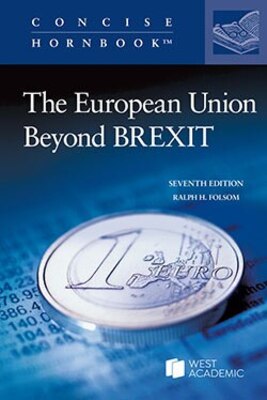
The European Union Beyond BREXIT
Ralph Folsom
This updated, advanced, detailed guide provides a comprehensive review of laws and policies of the European Union, including BREXIT's impacts and Beyond. Chapter 1 examines the history and growth of the European Union. Chapters 2 and 3 focus on critical EU processes behind lawmaking and litigation. Chapter 4 examines the free movement of goods, services, capital, and people (including mass migration). Chapter 5 covers a broad selection of internal EU business law regimes ranging from taxation to agriculture. The EU's complex external trade, foreign investment and customs law is analyzed in Chapter 6. Antitrust law and regulation of business agreements are covered in Chapter 7. The Treaty on European Union, the Treaty on the Functioning of the European Union, the EU Charter of Fundamental Freedoms, and a summary of the EU-UK 2021 Trade and Cooperation Agreement post BREXIT are reproduced in Appendices.
-
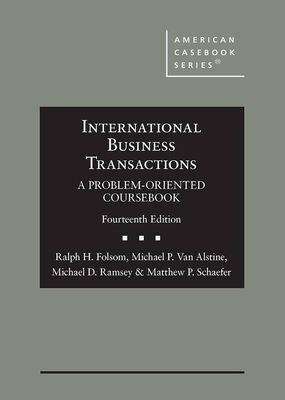
International Business Transactions: A Problem-Oriented Coursebook
Ralph Folsom, Michael P. Van Alstine, Michael D. Ramsey, and Matthew P. Schaefer
The 14th Edition of this popular problem-oriented coursebook introduces law students to the conduct of business in the world community. Problems on international contracting, digital trade and privacy, financing, regulation of imports and exports, licensing and technology transfers, trade-related intellectual property protection, foreign investment, and international business dispute resolution are included. The book provides current in-depth examination of issues business clients are likely to face, such as contracting for sales across borders, financing international transactions, defending against import competition, expanding exports and overseas markets, investing abroad and dealing with the United States-Mexico-Canada Agreement (USMCA), the World Trade Organization (WTO), and other trade agreements. The coursebook is designed to survey a wide range of laws involving trade, licensing and investment and to explore how issues and problems are addressed by lawyers as problem solvers and risk managers.
-
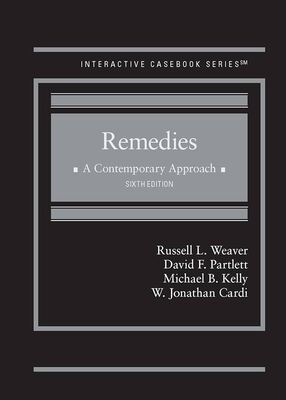
Remedies, A Contemporary Approach
Russell L. Weaver, David F. Partlett, Michael B. Kelly, and W. Jonathan Cardi
This new edition continues to execute our primary goal—to create a “teacher’s book”—a book that contains thought provoking problems (referred to as “hypos” or “Food for Thought” in the Interactive Casebook Series) designed to stimulate thought and produce interesting classroom discussion. The hypos and Food for Thought are woven throughout the chapters and are designed to help students learn doctrine, illuminate trends in the law, and ultimately produce better learning. A secondary goal was to include a focus on teaching “skills.” Many of the hypos place students in practical situations that they are likely to encounter in practice, and therefore encourage students to think about how they might handle those situations in real-life.
However, the book has been updated and refreshed with a number of new cases: K-Mare Corp. v. Oriental Plaza, Inc. (adequacy of legal remedies); Navajo Academy, Inc. v. Navajo United Methodist Mission School, Inc. (discretionary nature of equitable relief); Verenes v. Alvanos (the right to jury trial); Al Hirschfield Foundation v. Margo Freiden Galleries, Ltd. (civil contempt sanctions); Federal Trade Commission v. Trudeau (contempt sanctions); Susan B. Anthony List v. Driehaus (declaratory relief); Ride the Ducks of Philadelphia, LLC v. Duck Boat Tours, Inc. (requirements for preliminary relief); Habitat Education Center v. United States Forest Service (bond requirement); and National Collegiate Athletic Association v. Governor of New Jersey (contempt damages). In addition, it contains a new section explaining the pros and cons of nationwide injunctions, as well as a number of new Hypos and Food for Thought boxes.
-

You Might Go to Prison, Even Though You’re Innocent
Justin Brooks
Justin Brooks has spent his career freeing innocent people from prison. With You Might Go to Prison, Even Though You're Innocent, he offers up-close accounts of the cases he has fought, embedding them within a larger landscape of innocence claims and robust research on what we know about the causes of wrongful convictions.
Putting readers at the defense table, this book forces us to consider how any of us might be swept up in the system, whether we hired a bad lawyer, bear a slight resemblance to someone else in the world, or are not good with awkward silence. The stories of Brooks's cases and clients paint the picture of a broken justice system, one where innocence is no protection from incarceration or even the death penalty. Simultaneously relatable and disturbing, You Might Go to Prison, Even Though You're Innocent is essential reading for anyone who wants to better understand how injustice is served by our system.
-
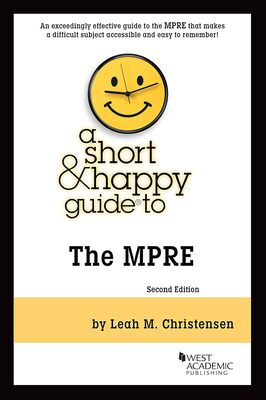
A Short & Happy Guide to the MPRE
Leah Christensen
This Short and Happy Guide provides students with the essential concepts and overarching themes that are most frequently tested on the MPRE. The Guide covers the rules of professional responsibility giving students the best introduction they can have as they begin their exam preparation.
-
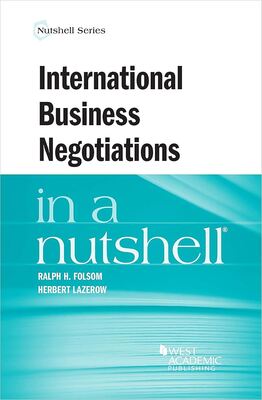
International Business Negotiations in a Nutshell
Ralph Folsom and Herbert I. Lazerow
International Business Negotiations in a Nutshell is designed for legal, business, and international studies. It first explains why international business negotiations are strikingly different from domestic negotiations. This Nutshell introduces the basics of negotiating international business transactions, then moves to specific negotiations of international sales agreements, letters of credit, foreign sales agents and distributors, international franchise agreements, international technology transfer agreements, foreign investment agreements, fundamentals and negotiation of international dispute settlement, negotiating choice of forum and choice of law clauses, and finally negotiating exit clauses in international business agreements.
-
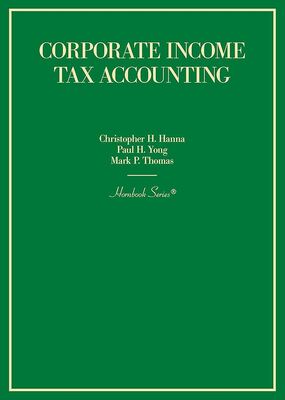
Corporate Income Tax Accounting
Christopher H. Hanna, Paul H. Yong, and Mark P. Thomas
Accounting for income taxes has become a critically important issue for both financial accounting and income taxation purposes in recent years. However, there is nothing new about the need to account for income taxes for purposes of presenting, or to opine upon, the financial accounts of corporations or other business entities. The process of accounting for tax matters has been a traditional aspect of the responsibilities of finance and taxation officers of business entities, particularly publicly traded corporations, for many years.
The nature of the process has long been familiar. In essence, there are a number of parties in this process: (i) business entities, (ii) tax administrations, (iii) financial accounting standards organizations, (iv) auditors of the business entities, and (v) tax strategists seeking to achieve overall tax/finance results for business entities. Each party has its own interests.
The purpose of this text is to discuss and explain the pertinent elements of the intersection of financial accounting and taxation. The goal is to: (i) articulate the reality of financial accounting and tax compliance in light of the new landscape entities face on such matters today; and (ii) set out a means by which entities can structure their tax planning and financial reporting in a manner to efficiently meet all applicable requirements. Key differentiators in the text are liberal use of numerical examples, excerpts from companies’ financial statements, and opinions on murky issues due to the complex and dynamic interdependence of financial accounting and income tax principles.
-
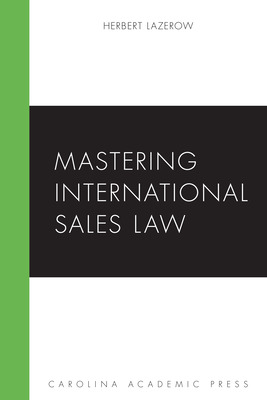
Mastering International Sales Law
Herbert I. Lazerow
This book is designed for the law student studying international sales contracts and for the many lawyers who want a quick introduction to the area. The field is of growing importance. In 1960 and 1970, the sum of U.S. imports and exports of goods constituted 6% and 8% of U.S. gross domestic product. In 1980 and 1990, that percentage rose to 17% and 15%. In the last three decades, the ratio of the value of imports plus exports to gross domestic product has hovered around 20%.
The principal focus is on the United Nations Convention on Contracts for the International Sale of Goods. The number of countries adhering to CISG now stands at 95. It includes all top seven trading countries (China, United States, Germany, Netherlands, Japan, Hong Kong and France) measured in total imports and exports. In addition to analyzing CISG, the book provides an introduction to two other topics of importance to international sales contracts: letters of credit and the U.S. income tax consequences of international sales.
-
Patent Law: An Open-Source Casebook
Ted Sichelman
Less than a handful of casebooks are truly open source, in the sense of being fully modifiable. Patent Law: An Open-Source Casebook is the first patent law casebook that provides adopting professors, students, and others the ability to fully modify its contents. This file comprises the casebook in its entirety, including the cover, table of contents, preface, and chapters covering historical and economic perspectives on patent law, an overview of the modern patent system, the patent document and its claims, subject matter eligibility, utility, disclosure, anticipation, obviousness, infringement, defenses, remedies, prosecution, challenges, ownership, and licensing.
-

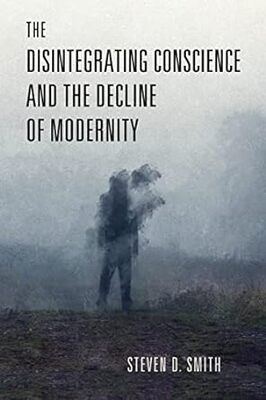
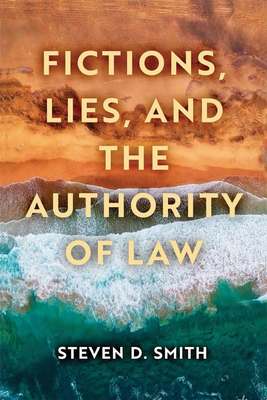
The disintegrating conscience and the decline of modernity
Steven Douglas Smith
Steven D. Smith’s books are always anticipated with great interest by scholars, jurists, and citizens who see his work on foundational questions surrounding law and religion as shaping the debate in profound ways. Now, in The Disintegrating Conscience and the Decline of Modernity, Smith takes as his starting point Jacques Barzun’s provocative assertion that “the modern era” is coming to an end. Smith considers the question of decline by focusing on a single theme—conscience—that has been central to much of what has happened in Western politics, law, and religion over the past half-millennium. Rather than attempting to follow that theme step-by-step through five hundred years, the book adopts an episodic and dramatic approach by focusing on three main figures and particularly portentous episodes: first, Thomas More’s execution for his conscientious refusal to take an oath mandated by Henry VIII; second, James Madison’s contribution to Virginia law in removing the proposed requirement of religious toleration in favor of freedom of conscience; and, third, William Brennan’s pledge to separate his religious faith from his performance as a Supreme Court justice. These three episodes, Smith suggests, reflect in microcosm decisive turning points at which Western civilization changed from what it had been in premodern times to what it is today. A commitment to conscience, Smith argues, has been a central and in some ways defining feature of modern Western civilization, and yet in a crucial sense conscience in the time of Brennan and today has come to mean almost the opposite of what it meant to Thomas More. By scrutinizing these men and episodes, the book seeks to illuminate subtle but transformative changes in the commitment to conscience—changes that helped to bring Thomas More’s world to an end and that may also be contributing to the disintegration of (per Barzun) “the modern era.”
-
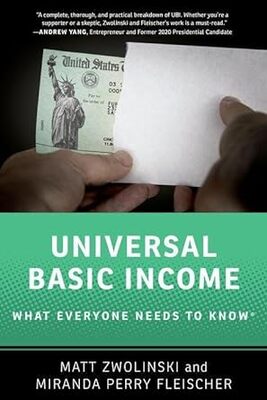
Universal basic income: What everyone needs to know
Matt Zwolinski and Miranda Perry Fleischer
The motivating idea of a Universal Basic Income (UBI) is radically simple: give people cash and let them do whatever they want with it. But does this simple idea have the potential to radically transform our society? Is a UBI the ultimate solution to the problem of poverty? Is it the solution to automation-induced unemployment? Can it help solve gender and racial inequality?
This book provides the average citizen with all the information they need to understand current debates about the UBI. It recounts the history of the idea, from its origins in the writings of 18th century radical intellectuals to contemporary discussions centered on unemployment caused by technological advances such as artificial intelligence. It discusses current pilot programs in the United States and around the world, including how much (or little) we can learn from such experiments about how a large-scale UBI would fare in the real world. It explores both the promises and pitfalls of a UBI, taking seriously the arguments of both supporters and detractors. It also explains why the UBI has attracted supporters from all across the ideological spectrum--from conservatives to liberals, libertarians to socialists--and what the implications of this fact are for its political future. -
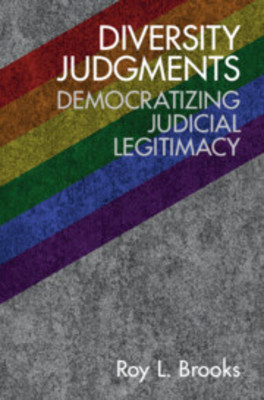
Diversity judgments : democratizing judicial legitimacy
Roy L. Brooks
The US Supreme Court's legitimacy-its diminishing integrity and contribution to the good of society-is being questioned today like no other time in recent memory. Criticisms reflect the perspectives of both 'insiders' (straight white males) and 'outsiders' (mainly people of color, women, and the LGBTQ community). Neither perspective digs deep enough to get at the root of the Court's legitimacy problem, which is one of process. The Court's process of decision-making is antiquated and out of sync with a society that looks and thinks nothing like the America of the eighteenth century, when the process was first implemented. The current process marginalizes many Americans who have a right to feel disenfranchised. Leading scholar of jurisprudence Roy L. Brooks demonstrates how the Court can modernize and democratize its deliberative process, to be more inclusive of the values and life experiences of Americans who are not straight white males.
-
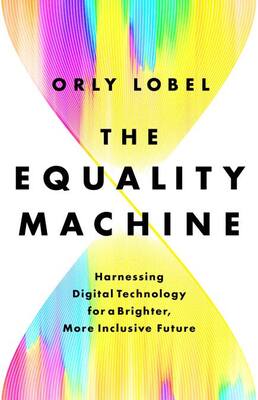
The equality machine : harnessing digital technology for a brighter, more inclusive future
Orly Lobel
Much has been written about the challenges tech presents to equality and democracy. But we can either criticize big data and automation or steer it to do better. Lobel makes a compelling argument that while we cannot stop technological development, we can direct its course according to our most fundamental values. With provocative insights in every chapter, Lobel masterfully shows that digital technology frequently has a comparative advantage over humans in detecting discrimination, correcting historical exclusions, subverting long-standing stereotypes, and addressing the world’s thorniest problems: climate, poverty, injustice, literacy, accessibility, speech, health, and safety. Lobel's vivid examples—from labor markets to dating markets—provide powerful evidence for how we can harness technology for good. The book’s incisive analysis and elegant storytelling will change the debate about technology and restore human agency over our values.
-
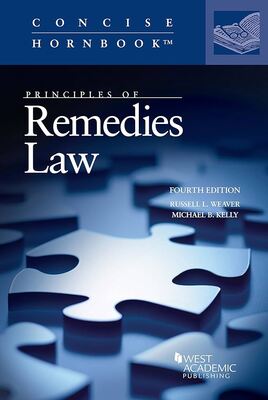
Principles of Remedies Law
Russell L. Weaver and Michael B. Kelly
This book is written in a student-friendly style designed to facilitate learning and comprehension. The book contains the latest decisions from the United States Supreme Court and the lower federal and state courts.
Printing is not supported at the primary Gallery Thumbnail page. Please first navigate to a specific Image before printing.